
The Seventh Sunday after Pentecost – 7/16/2023 This sermon has been transcribed from a live video. To view a video of this sermon, please click here.
I speak today as a sinner to sinners, as the beloved of God to God’s beloved, as one called to bear witness to those called to bear witness. Amen. Please be seated
As I began praying about the sermon for this Sunday and read our wonderful passage from the Gospel of Matthew, I thought about a poem that was written by Edgar Albert Guest. Edgar Guest was the first poet laureate of Michigan. He was born in 1881, and he died in 1959. His path to poetry came through the Detroit Free Press. When he was 16 years old, his father died, and he had to drop out of high school and begin to provide for the family. And so he got a job as a kind of runner at the Detroit Free Press, and then he worked his way up.
His poetry is not to be confused with high art, but there’s something really powerful in what he does. And that was because he wanted to somehow approximate the beauty of verse, as he called it, and make it appeal in the vernacular of everyday life. And so he uses things like contractions and bits of slang because he wants to somehow make the words come to life. And the poem that I had in mind is A Package of Seeds. It’s in your bulletin on page seven. And for those of you who are following along at home, it’s going to come right up next to me. And it goes like this:
A Package of Seeds
I paid a dime for a package of seeds
And the clerk tossed them out with a flip.
“We’ve got ‘em assorted for every man’s needs,”
He said with a smile on his lip.
“Pansies and poppies and asters and peas!
Ten cents a package and pick as you please!”
Now seeds are just dimes to the man in the store
And dimes are the things he needs;
And I’ve been to buy them in seasons before,
But have thought of them merely as seeds.
But it flashed through my mind as I took them this time
“You have purchased a miracle here for a dime!”
“You’ve a dime’s worth of power no man can create,
You’ve a dime’s worth of life in your hand!
You’ve a dime’s worth of mystery, destiny, fate,
Which the wisest cannot understand.
In this bright little package, now isn’t it odd?
You’ve a dime’s worth of something known only to God.
I find this a beautiful poem and appropriate for today’s gospel, not merely because it talks about seeds, and in our gospel today we learn about seeds, but because there is something to this message. To give a bit of context to this poem. Guest is writing this poem at a time in which Detroit industry is being painted by Rivera, in which the city is ascending as an economic and manufacturing powerhouse in which we were becoming known as the arsenal of democracy. All of these things are powerful movements and all of these forces exerted a human cost.
Part of what was lost was that sense that we have relationships with ourselves in our world that resists commodification and monetization. And these relationships make us the human beings we are. The same animus drove our founders that found this church. And so, when Guest talks about seeing the miracle that is a seed, and not merely as something to be monetized, he’s picking up on something powerful about what it means to live life.
You see an echo of it in Arthur Miller’s Death of a Salesman, when Willy Loman says that a man is more than a rind of an orange you can cast away when he’s no longer useful. There is a plea in this poem for humanity, but that humanity is found by hearing a message and meeting a messenger. And that message is the miracle of the seeds.
The fact that the seeds have this incredible miraculous moment, which we still cannot predict perfectly, and which we still don’t understand perfectly even though we might be biologists. That miraculous moment when a seed will break open and life will start anew, it is a miracle that happens to this day. Something we cannot control but something we can plan around and hope to benefit from. And that message of the miracle is often hidden in plain sight. And standing behind that miracle is the messenger, is God. And so, Guest writes, in this seed there is a power and mystery known fully only by God.
Now, this idea of having a message that is always around us and that we miss constantly, that we take as a given and not a gift. This is something really important for us to look at today in today’s gospel, because in today’s gospel that is the whole purpose of the Parable of the Seeds. The person sowing the seeds, the farmer throws the seeds into the air and trusts the wind and the seeds flow and fall over this great spray of land. Some of it is hard packed, some of it is rocky, some of it is shallow and some of it is good soil.
And that mystery of that miracle and that message is the central point of today’s gospel. It speaks to one of two ways that Jesus communicates in the Gospels. There are two ways that Jesus communicates. One way is by engaging in broadsides, in broadcasting a truth and shouting it out. So when Jesus says, “Blessed are the poor,” that is a word that has been given to everybody. When Jesus says, “Repent, for the kingdom of God is here,” that is a word that is given for everybody. And it is up to us to have the ears to hear it.
And so one message in today’s parable is that word is always there. It’s not just the word of scripture, but it’s the word of everyday life. It’s the word of everything. And the question you and I have to struggle with today is whether we are ready to receive that seed, that message from God. And yet, there is another mode of communication that you see in the poem and in the parable. And that is that in addition to these moments where Jesus will speak to everybody and speak over the heads of even His disciples to the crowds and to us, there is also in the Gospels another mode of communication of dialogue.
And dialogue is different than broadcast. In a dialogue, there is transformation and change. And we see those moments of dialogue in Jesus’s ministry when He says to Peter, “Peter, do you love me?” Or He says to the Samaritan woman in chapter four of the Gospel of John, “Go and call your husband and bring him here.” And she enters into that dialogue in which she reveals herself.
That dialogue is key as well, because what happens in dialogues is they have a kind of moment of transformation. It’s an exchange of information. The word “conversation” comes from conversio, from the Latin and the Italian, to converse, to trade a word. But also, in that exchange, there is a kind of intimacy that goes beyond words, that is shaped by that encounter between the two people speaking.
And the wonder of Christianity, the power of Christianity, the promise of Christianity is not just that you get to attend yourself to the seeds of God that have been spread abroad in the world that you need to listen for and look for in your life. The mystery and beauty of Christianity is that you have been invited into a dialogue with Jesus, into a dialogue with God. Those two modes of communication are peculiar to Jesus. He speaks like every prophet, and calls things as they are, and speaks the truth that is out there, hidden in plain sight. And yet, He also invites dialogue with you, and with me. And that is the mystery.
And in today’s gospel, that mystery of dialogue is represented by the soil, because you and I can choose whether or not we accept that invitation to dialogue. When Jesus is speaking about earth that has been pounded flat and made into a path, or soil that has become shallow, or soil that gets crowded by weeds, Jesus is not engaging in a kind of categorization of who you are at the most dispositional level of your being. You can’t just take refuge or find despair in the fact that you happen to be shallow in one place. But all of us are meant to see in those different kinds of soil an invitation to become good soil. And all of us have that invitation in today’s gospel to let that seed of God sink in and break open and grow.
That seed of God is key. It’s what separates Esau from Jacob. Esau has everything in today’s reading from Genesis. He’s hairy, he’s masculine, he’s a good fighter, he has his father’s approval. And gentlemen, you know how much that means. And yet, he trades his birthright, the thing that should be most precious to him. He mistakes it. He gives it in exchange. He monetizes it so that he can have a meal. Don’t trade your birthright in Christ. And you see that seed in our reading from Romans today. The Spirit of God dwells within you. When Paul is speaking about that, he speaks of it like a seed that is planted in your soul. And that’s why the law cannot convict you any longer, because Christ’s Spirit lives in you. And that is why there is no fear or condemnation before God, because that seed lives in you. That Spirit lives within you. And you are covered and filled with God already through Jesus Christ.
And in today’s Gospel, the work that we are invited to do is to become good soil. And the easy way to understand good soil in today’s gospel is that good soil has been broken, right? When you create soil, you have to till the ground. You have to hit it with something hard and sharp and turn the inside out. And you have to break that soil open because you need to get air in there, because when you have air and the seed and the soil, the soil becomes friable and able to give life.
That’s how seeds break open and grow. And you and I need to become vulnerable before God. We need to befriend the brokenness we experience with God. We need to understand that that upturning of ourselves, which happens to all of us, that all comes from God, and can be redeemed by God, the extent to which we let that seed sink in.
A friend of mine, who I adore, his name is Dan, and he was a jazz trumpeter for several years until he got his life together. And he married late in life, he married a woman named Star. Dan was from Missouri, and anytime he ever worked, it was because he needed money. And Star was from Georgia. And Star let him know in the first time of their married life together that she wanted a garden. And not just a garden, but one of those gardens that you see in Georgia. You know the idea I’m trying to convey. And Dan was a little reluctant and I kind of hit him upside the head, like this is your chance man. You just wait on her and you will be in like Flynn. This is marital advice. You please the wife, your life will be happy, I promise you.
And so he began to move what he said was dirt. And she said, honey, this is soil. This is friable. And so he began to dump out the soil. And then he took his foot out of his Birkenstock and he dipped it in the soil. And he pulled his foot out and he saw how clean it was. And he said to me after the fact, and I said to her, you’re right. It is soil. It’s not dirt. And there was this utter transformation. She beamed because she saw in that work together the message he was trying to send her and the messenger he was. And that he loved her. And that he now could see things as she saw things. The dialogue had been transformative.
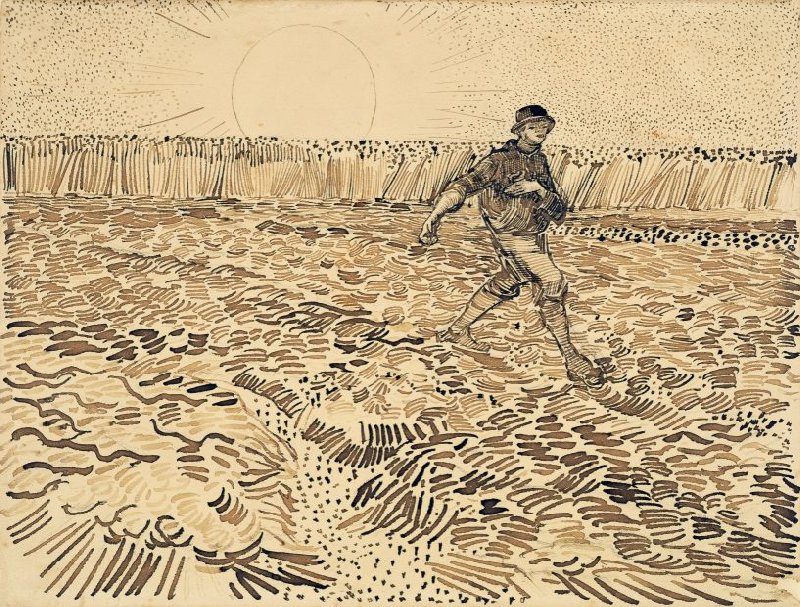
The last thing I’ll share with you today is from the bulletin cover. It’s from Vincent Van Gogh. This is one of his early studies that he did in 1888 called The Sower. We tend to think of Van Gogh as this troubled, strange artist who somehow conveyed things that were beautiful, and that’s because he was. But he also began his whole life as a missionary to coal miners in France. Van Gogh spent his entire life looking for God.
And this passage that we read today in Matthew was one of his major themes. He constantly shows a sower sowing seeds. And he wants to convey not just a moment of the sublime, which is that awesome, terrible moment of having just a bit of perspective because your feet are one foot off the ground. But he wanted to convey, through this painting, transcendence, because behind the sower in this painting, you have the sun and the sun is shining and behind that sun is God. And this image for Van Gogh conveyed redemption for him. The hope that inspired him as an artist that he would, by receiving the gift of the seed of his life and the gift of God and the seed, he would find his way as an artist.
What message is God surrounding you with today? What has been hidden in plain sight that you have overlooked? How can you break open the soil of your soul so that that seed of God can sink deeper? And how can you engage in a powerful dialogue with Jesus who delights in you and loves you and is waiting for you, and is willing to listen to every word you say?
Amen.
 Rev. Dr. William J. Danaher Jr.