
The Fourth Sunday after Pentecost – 6/25/2023 This sermon has been transcribed from a live video. To view a video of this sermon, please click here.
I speak to you today as a sinner to sinners, as the beloved of God to God’s beloved, as one called to bear witness to those called to bear witness. Amen.
“Are not two sparrows sold for a penny? Yet not one of them will fall to the ground apart from your Father. And even the hairs of your head are all counted. So do not be afraid; you are of more value than many sparrows.”
As I was thinking about this piece of scripture and letting it sink all the way into me over the past week, I found myself actually thinking about the poet Anne Sexton. She won the Pulitzer Prize in 1967 from Boston, was incredibly beautiful, was a fashion model, and became a poet that delved into and created something known as a kind of confessional poetry. There was not a desire that she left uncovered in her poetry and it shocked people in 1967. It would probably still even shock some of us today.
Sexton died by suicide in 1975, and her last book of poetry was called The Awful Rowing Toward God. And it begins with the poem that I put in front of you today in your bulletins. And for those of you at home, it will be appearing right here. And I want to begin with this.
A story, a story!
(Let it go. Let it come.)
I was stamped out like a Plymouth fender
into this world.
First came the crib
with its glacial bars.
Then dolls
and the devotion to their plastic mouths.
Then there was school,
the little straight rows of chairs,
blotting my name over and over,
but undersea all the time,
a stranger whose elbows wouldn’t work.
Then there was life
with its cruel houses
and people who seldom touched-
though touch is all-
but I grew,
like a pig in a trenchcoat I grew,
and then there were many strange apparitions,
the nagging rain, the sun turning into poison
and all of that, saws working through my heart,
but I grew, I grew,
and God was there like an island I had not rowed to,
still ignorant of Him, my arms, and my legs worked,
and I grew, I grew,
I wore rubies and bought tomatoes
and now, in my middle age,
about nineteen in the head I’d say,
I am rowing, I am rowing
though the oarlocks stick and are rusty
and the sea blinks and rolls
like a worried eyeball,
but I am rowing, I am rowing,
though the wind pushes me back
and I know that that island will not be perfect,
it will have the flaws of life,
the absurdities of the dinner table,
but there will be a door
and I will open it
and I will get rid of the rat inside me,
the gnawing pestilential rat.
God will take it with his two hands
and embrace it.
I find this an incredibly beautiful poem because Sexton is speaking out of her perspective as someone who suffers profoundly with mental health issues. She suffered from depression. She suffered from suicidality, and her life was a struggle even though on the outside everything looked amazing. She was beautiful. She was tall, she was thin. All the things that seemed to be admired at the time, glamorous, accomplished. Inside, she was dying.
And yet she had inside of her, among all the desires she looked for in this life, all the things she tried to give voice to, she identified in her life a deep desire for God. And in this sense to me, she is a witness to us. So many of us inhabit lives in which we experience devastation that no one sees. So many times we inhabit worlds in which we can, to the naked eye, appear quite accomplished, and yet inside we struggle. So many of us are crippled by addiction and disease and death often in ways that would scarcely not be seen if it wasn’t for the fact that we might tell a friend.
All of us know that brokenness. It’s the fabric of being a human being. It comes to us whether we are ready for it or not. It comes to us no matter how successful we are. It comes to us no matter how much money we have. We all will experience that brokenness in life, in one way or another it comes. And all of us experience that desire for God. It is a fundamental fact of human nature. We all want to know and love, and more importantly, to be known and loved by God. This is baked into who we are as human beings.
And the tragedy of life as we often try to place other things into that place where God should be, and we find ourselves worshiping a career that is quite ephemeral. It’s here today and gone tomorrow, worshiping our accomplishments, our place in the world around us, our community, worshiping even the success of our children. All of these things come and go and have no place in the place that God should be, and we become miserable without understanding that desire for God and God’s desire for us.
So all of us, I think, know what it feels like to be rowing and to be working really hard and to be looking for God and to be taking refuge in the fact that we are growing and rowing towards God. Though the oarlocks be rusty and though the sea might be heaving. And though we might feel lost and though we might feel tired, all of us know what it means to search for God.
And because of this, I am so grateful for this poem. It identifies something super powerful to me, and I suspect to each one of you. I bring it up today also because it seems to capture a perfect mirror of our reading today from Matthew. It mirrors the conflict that is in the midst of this passage where Jesus says that intimate relations will be at odds with each other. This is certainly Sexton’s experience in her life. Her family was quite broken and she perpetuated that brokenness on others. And that to us is the greatest human tragedy, right? We experience damage and we pass it on.
Today’s gospel knows that damage well, and Jesus speaks to it without any flinching. And that’s because you can see it throughout our scriptures. There is the acknowledgement that conflict and struggle and brokenness will exist. We see it, for example, in our reading today from Genesis, when the moment in which the boy who was promised comes to Abraham and suddenly the child that he’s had by his handmaiden became detested to Sarah. And Ishmael is sent away to die.
All of us know that brokenness, and yet all of us know God’s presence. And in the scriptures today from Matthew, there is the promise that our life is not a lonely rowing toward God. But rather God has always been coming to us. God is with us now, even when it sometimes feels as if we are the only one struggling. And this is the message Jesus delivers today when He says that you are much more valuable than many sparrows, as beautiful as sparrows are. And that God has counted the hairs on your head.
Today’s gospel is an invitation for us to make room for God. When Jesus speaks about family relations and all the conflict therein, there was nothing that comprised your identity more than being connected to your family. In fact, it was knit within the names of the Jews, Simon Barjona, Simon, son of Jonah. This was the way in which Simon knew who he was, and the community knew who he was. And so when Jesus speaks these words, of that breaking with your own family, it was dangerous talk, more so then than now.
And you and I know that there is a point in life when you have to define yourself in relation to your family. And the gospel asks us to find as your deepest point of identity, your relationship with God. And in that place of family strife and connections, we can place everything you use to create your identity, the new job you have, or the new car you bought, or the new things you’re doing, or the exciting things that are happening to you, or the fact that you’re looking forward to going on vacation, like it’s something that you can barely control. All of these things are good. They’re part of what it means to be human, but none of these things can get in the way of your relationship with God.
And my task for you this summer is to make room for God. You’ll notice that I didn’t say make room for church. Now, I would love it if you make room for God by coming to church. I have an interest in this relationship, but I am more invested in your relationship with God. And if getting in touch with God means stepping back from church for a bit, then God go with you. Because your relationship with God, that inner journey is more important than any kind of outward observance of religion.
And when you ask yourself the question, how can I get in touch with God? Be creative, think about what it is that you need to truly address. I hear often people who say, well, in the summertime I find God in nature, not in the church. And I find that hard to believe from my perspective, because when I get into nature in the summertime, I don’t make space for God, I make space for ticks. I’m not a huge fan of nature. I don’t have those wonderful Emersonian epiphanies where suddenly I see the world around me all interconnected. I just see this is a hard hike and I can’t wait to get back home into some air conditioning. And I’m at an age now that when I go to the beach, I don’t make space for God. I make space for skin cancer. I just find that just like I spend all my time just policing this incredibly fragile skin that God has given me.
What does it mean to make space for God? I think that Sexton actually does this out of necessity. She goes through everything in her life that is a strong desire in prayer and contemplation, and she finds herself exhausted and admits her spiritual poverty and turns to God in prayer. That is what it means to make space for God. Admit your spiritual poverty and make room for this God who is coming towards you.
Everything in Matthew, everything we read is predicated on the fact that it is Christ Jesus who always comes to us first. And so when Jesus gives these words today in Matthew, His point is not to somehow make you hold fast to your own self-sufficiency, but rather to recognize your spiritual poverty and the inner journey that makes its way into your soul and out through your actions when you return the love that God has for you in Christ.
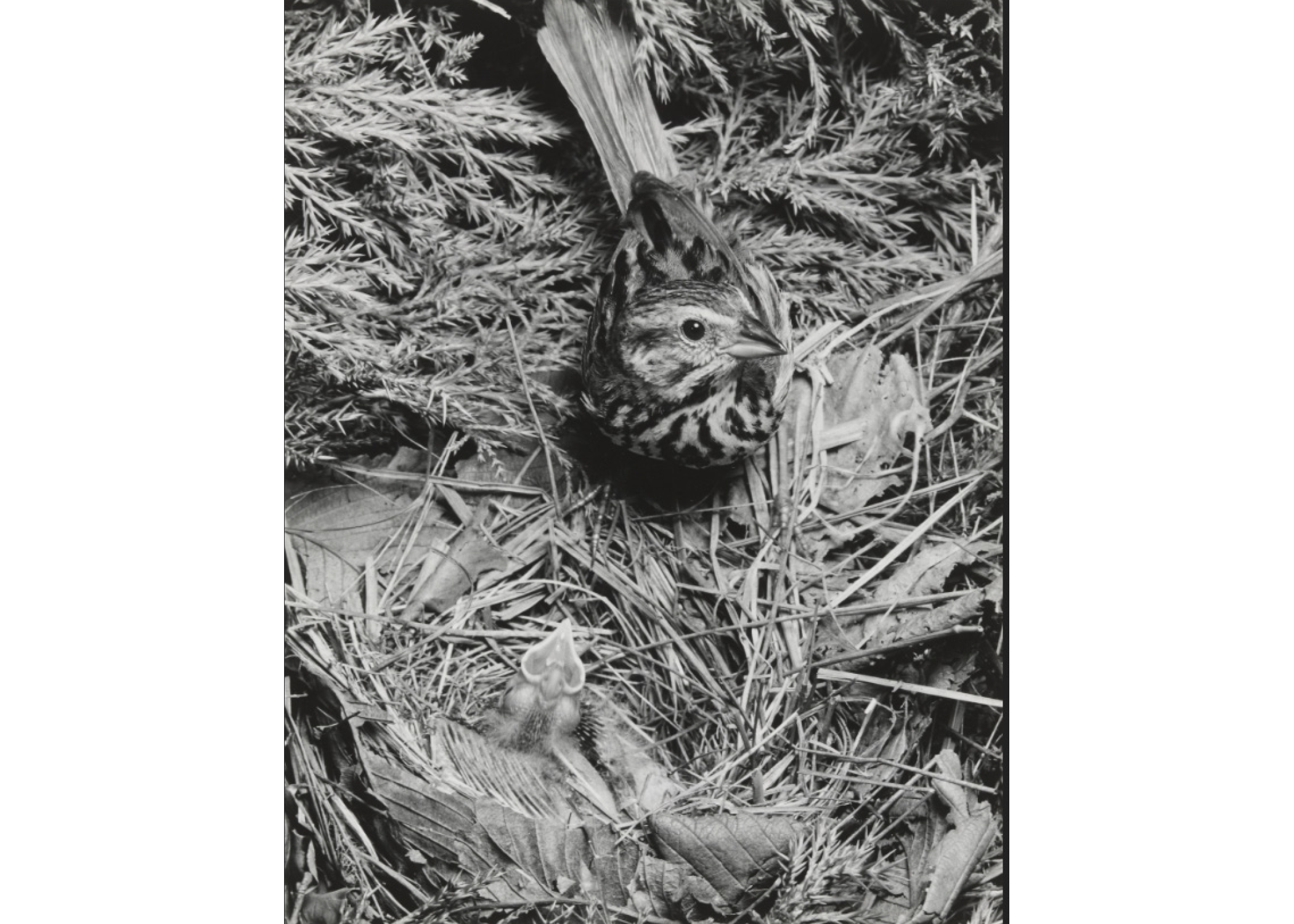
The final piece of art I want to share with you today is from Eliot Porter, and it’s an incredible piece, the Song Sparrow. It’s just meant to be a little trigger to you to maybe help your prayer life this summer. And the reason why I love this photo is it’s of a sparrow, and it’s gorgeous, and it’s so easy initially to miss the sparrow in the picture because it’s all black and white. But once you see the sparrow, you can never see the background again. Once that sparrow emerges in the picture, you cannot keep your eyes away from it and you see it as beautiful. So are you in God’s eyes. That is the assurance of today’s gospel. So are you. You are of more value than many sparrows.
And finally, as a way to close, I’ve asked Veronica to sing a song that is inspired by today’s scripture. His Eye Is On the Sparrow.
Why should I feel discouraged
Why should the shadows come
Why should my heart feel lonely
And long for heaven and home
When Jesus is my portion
My constant friend is He
For His eye is on the sparrow
And I know He watches over me
His eye is on the sparrow
And I know He watches me
I sing because I’m happy
I sing because I’m free
His eye is on the sparrow
And I know He watches me
His eye is on the sparrow
And I know He watches me
“Let not your heart be troubled,” His tender words I hear,
And resting on His promise, I lose my doubt and fear;
Though on the path He lead me, just one step I may see;
For His eye is on the sparrow, and I know He watches me;
His eye is on the sparrow, and I know He watches me.
I sing because I’m happy
I sing because I’m free
For His eye is on the sparrow
And I know He watches me (He watches me)
And I know He watches me (He watches me)
And I know He watches me
He watches me
 Rev. Dr. William J. Danaher Jr.