Father’s Day – 6/18/2023 This sermon has been transcribed from a live video. To view a video of this sermon, please click here.
I speak to you today as a sinner to sinners, as the beloved of God to God’s beloved, as one called to bear witness to those called to bear witness. Amen.
At the end of May this year, I had a really interesting exchange with one of my professors. I’m getting a graduate degree at Michigan, and this professor is so brilliant and so wonderful. She’s a young woman, which is so exciting seeing someone at the top of their field already just providing such incredible insight and knowledge.
And I caught Covid and so I missed three days of classes. Three whole days of classes, 20 hours of classes. And I was a little nervous. And so I asked for a Zoom meeting with her and she immediately said, of course. And The Zoom meeting came up and I got online and I was waiting and waiting and waiting. And so I sent an email where I said, hello, I’m on. And so I kind of parked it over in the corner of my screen while I was working on a million other things. And then I checked back to see my email and she sent me several emails saying, I’m sorry, I’m sorry. Could you please just call me on my cell?
And so I called her on her cell and she said to me, my daughter fell at school and she hit her head and we’re afraid that she has a concussion and she’s at the hospital. Do you mind if we have our meeting while I drive to the hospital? And I said, well, I think you probably have more important things to deal with right now. But let’s just talk. And I said, is this your first child? And she said, yes. I said, did they tell you that your child passed out? And she said, no. They said she never passed out. I said, well, you know, operating a daycare center and having been in education for several years, they’re probably just being really careful and doing a concussion protocol to make sure everything’s fine. I think everything’s going to be okay. Is there anything I can do for you? And she said, would you please pray for me?
Now, this professor is from Turkey and is not a Christian, and I have a PhD from Yale University in religious studies. None of my professors ever asked me to pray for them. But I was so touched that she asked for my prayers, and so I said I would, I would lift her up in prayer, and then I texted her a prayer that I was offering. I wrote her and I said,
“Professor, please let me offer a quick note of reassurance. You will never be closer to God than in these moments when you are anxiously waiting and keeping vigil for your daughter, God’s love is as your love is even now, only more. This means that the space where you are right now is holy, even in the midst of all the difficulties, fears, and frustrations. Your love for your daughter is your prayer. God hears the prayer of your love and is waiting with you. Bill.”
And she wrote me back and thanked me and said it was a precious gift. And I asked her to please let me know how things turned out. I would be waiting by the phone. Send me a text to know if she’s okay. And she did. And this was such a beautiful exchange and I was thinking a great deal about that shift in roles that suddenly happened where it went from professor and student to kind of priest and parishioner, but not quite. It actually became one of father and daughter. And what was beautiful about it in particular is after the crisis had passed and I went into school and we met in person for the first time, she thanked me, but it was so clear that the roles were back to professor and student. And she loved asking challenging questions, and yet between us, there was always this little wink. We’d know that we’re playing roles and we saw that kind of connection underneath it.
Now, I share this story with you because I felt like I hit a kind of strange turning point in terms of being a father. I’m getting better at being a father, it’s strange. And fatherhood is something that I’ve had a lot of learning to do as a biological father, and I’ve failed in a number of ways. They say that fathers need to be present, they need to provide, and they need to protect their children. And I certainly have provided, and I certainly have protected, but not totally. There have been mistakes. And in terms of presence, well, I’ve got a demanding job and that third P, presence, haunts me. I haven’t always been present and I mourn that.
At the same time, I am more aware because of my position, that to be a father is not merely to be a biological father. That part is quite easy in some ways. We find ourselves in the role whether we like it or not, but there’s spiritual fathers that we all play for each other. We all need mentors. We all need coaches. We all need people who lift us up and protect us and have our back, and in the midst of it somehow observe that dance in which a true father does not rescue totally, but encourages and helps a person grow. There is something powerful in the spiritual fathers we have that exceeds not only whether or not we were biological fathers, but whether or not we actually were fathers or males.
My mother in some ways played the role of father to me because my father was a pilot and traveled a great deal. He couldn’t be present. And my own biological father was someone who was excellent at hunting and shooting guns and riding horses and doing things that are dangerous. But he had never had a son who was an athlete. And so, when I would go out to a major competition and I was an intercollegiate athlete, division one, I would always go into these moments without – you know, other fathers seemed to know exactly what to say. And so my mother stepped into the role and she said to me once, I want you to be a champion today. Win or lose. Compete well, compete fair. That’s all you need to be is a champion. My mother in that moment was a father to me. She stepped in, as so often we need to do.
Now, all of this I share with you because when we celebrate Father’s Day, what I want you to see as well is the fact that fatherhood is something that is a kind of role that we grow into. Fatherhood is a form, in other words, of discipleship. And as being a disciple of Jesus, we grow into what it means to follow Jesus. We are given an opportunity to be transformed by following Jesus wherever we are. And that means that to be a good father means to be a good disciple. And it also means that the model of fatherhood in the scriptures is not the fatherhood of God so much as the love of God.
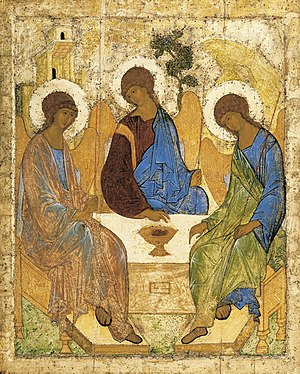
Look, for example, at our reading from Genesis today, Abraham learns that he is going to be a father, and the person who delivers it is God as three persons. These three heavenly visitors come to him by the Oak of Mamre, and he welcomes them and serves them, and they deliver him the promise and expectation and hope and blessing that he in his old age would be a father. And Andrei Rublev, in a painting that you have before you today on the bulletin, and those of you at home will see it right over here, composed this image of God as Trinity based upon our reading today from Genesis. For when God came to see Abraham in the form of three messengers, so Rublev says, God’s identity as three persons, as a community of love, held together by infinite self-giving that God was revealed in the same moment as Abraham is revealed as the father of nations.
So the model in the scriptures of fatherhood is God’s love as a whole through three persons, and that means that you and I, when we think about fatherhood, need to think not only about our biological fatherhood or the biological fathers we’ve had, because always that will be just a small portion of what it means to be a father. But you and I will see in that relationship with God, a kind of vision of love and sacrifice.
There’s a poem I have before you today that captures this perfectly. It’s by Robert Hayden, who was a magnificent poet, and it’s just stuffed in as an insert in your bulletins. It’s called Those Winter Sundays.
Sundays too my father got up early
and put his clothes on in the blueblack cold,
then with cracked hands that ached
from labor in the weekday weather made
banked fires blaze. No one ever thanked him.
I’d wake and hear the cold splintering, breaking.
When the rooms were warm, he’d call,
and slowly I would rise and dress,
fearing the chronic angers of that house,
Speaking indifferently to him,
who had driven out the cold
and polished my good shoes as well.
What did I know, what did I know
of love’s austere and lonely offices?
There are two things I really want you to see in this poem about fatherhood today. The first is the love of Hayden’s father for him, which was that love that was a kind of base note. A kind of ballast that held everything together. And it was so important, and yet it was hidden in plain sight. Hayden entering into that space of a 16-year-old full of ambition and anger, as so many are, does not know his father’s love, even though it was evident in the fact that the cold was being driven out by the fact that his father got up at the crack of dawn to heat the house and to wait on him and serve him.
That is a picture of a father’s love. In the last lines of the poem, what did I know? What did I know of love’s austere and lonely offices? This, too, is a depiction for us of that interconnection between discipleship and fatherhood, because none of us starts out being great fathers. We have to grow into it, and none of us starts out knowing how to love in this world or to be good Christians and sharing our love. We learn to love. And love is seen here as a kind of daily sacrifice, a kind of making space, a kind of support for his family. So love is a project that we learn. It’s what we need to do, no matter what role we play.
The second thing I want you to see in this poem, which I think is so critical, is that it happens on Sunday. His father is polishing his son’s shoes so his son can go to church and be presentable. Hayden is African-American and so he knows how important it is to show up in church well-dressed. And he polishes his son’s shoes even though his son evidently didn’t notice and probably didn’t deserve it. And does that so that he could be turned out and could represent.
It doesn’t say that Hayden’s father went within the church, and I have a suspicion that he probably stayed home and rested. And that is its own message to us because that last line, “love’s austere and lonely offices,” the word “office” is meant to refer to daily prayer that’s done at a time. And so what Hayden is saying is that while the family is going to worship on Sunday, his father is observing a daily office of love. The two go together, you see.
There are two more points I want to make about today’s sermon about fatherhood. The first is from Romans, which is a way to connect not only fatherhood with love, but the growth that we have in fatherhood. That wonderful moment where Paul says, we boast in our sufferings knowing that suffering produces endurance and endurance produces character, and character produces hope, and hope does not disappoint us. This can seem like making suffering into the breakfast of champions, right? I kind of want to say to Paul when I get that far in the letter, like, give it a rest, Paul. We understand. We have to stand out in the cold and beat our chests. I get it. Very macho. I get it. Cool, you win. But in fact, what he’s trying to say to us is that true discipleship means that we persist.
And that’s the fourth P to being a father that I want you to hold onto today. Provide, protect, be present, and persist. Persist because, as Paul says, God’s love has been poured into our hearts through the Holy Spirit that has been given to us. We are never finished being a father, and if we’re at all blessed, we’ll get a bit better at it. And the people that will benefit from our fatherhood will be sometimes the people we’re related to biologically, but oftentimes it will be the person that needs a bit of completion because a father has shown himself to be all too human. And I am so grateful for every father figure that I have had, man or woman, who has encouraged me and had my back and protected me and was present.
The final point I want you to see today is from our gospel, because running through the love of God and running through the mission of the church is the fact that that sacrifice and vulnerability, which is part of being a Christian, that sacrifice and vulnerability, which has to be the way in which we share the gospel, that goes with the grain of God’s love and justice. Our collect asks us to pray for the steadfast love of God. That is a riff on the word sedeq in Hebrew, loving kindness. And sedeq lies behind God’s covenant. God will be always our God through loving kindness, and that is why the mission of the church always has to be based in that loving kindness. Whatever work we do of justice or mercy.
And standing behind that loving kindness is the figure of Jesus Christ. The disciples were following Jesus who went into the world and was betrayed even though He healed the sick; who was crucified, even though He cast out demons; who gave himself fully because the love of God was His calling. It is our calling too. And every place we are, not only when we are off following the exact imprint of mission that Jesus speaks about, but that closer mission we have when we fulfill all the roles we are called to fill of being fathers and mothers and all other things.
May God’s love guide you and inspire you. May you learn the power that comes from relying on God as you provide, protect, are present, and persist.
Amen.
 Rev. Dr. William J. Danaher Jr.